
Air Filtration Services — Cleaner Air Starts with Better Filtration.
Here is something most homeowners do not know: the standard 1-inch filter in your HVAC system was designed primarily to protect your equipment, not to meaningfully improve your indoor air quality. It catches the large particles that could damage your blower motor and coils. It does very little for the particles that affect your health.
Each time your HVAC system runs, dust, pollen, pet dander, mold spores, bacteria, and fine particles from wildfire smoke move through your home. A standard filter captures only a fraction of them. The rest continues circulating through your system and back into your living spaces all day, every day.
The answer is not changing your filter more often. The answer is upgrading to a whole-home air filtration system that captures the particles that matter most. Integrated directly with your HVAC system, it works automatically to deliver cleaner air in every room of your home.
Power Electrical, Heating & Cooling Services installs AprilAire whole-home air filtration systems for homeowners across the Denver metro area. High-efficiency media filters, complete filter upgrade systems, and airflow improvements that deliver measurably cleaner air without restricting your HVAC system's performance.
Why Air Filtration Matters:
What Your Standard Filter Is and Is Not Doing
Your HVAC system circulates all the air in your home approximately every hour, passing it through your filter before distributing it back through your vents. In theory, this means your filter has the opportunity to capture indoor air pollutants continuously. In practice, the effectiveness of that filtration depends entirely on what filter you are using.
Standard 1-inch filters — MERV 1 to 4
These filters capture large visible particles such as carpet fibers, lint, and large dust clumps. They were designed to prevent those large particles from accumulating on your HVAC equipment and damaging it. They are not designed for, and are not effective at, capturing the particles that affect your health. Most of what makes you sneeze, triggers your allergies, and accumulates in your lungs passes right through a standard filter.
What standard filters miss:
- Fine dust particles — the ones that stay airborne the longest and penetrate deepest into your respiratory system
- Pollen — tree pollen, grass pollen, and weed pollen particles that trigger allergy symptoms
- Pet dander — the microscopic skin flakes that cause allergic reactions
- Mold spores — particularly relevant in Colorado basements and crawl spaces
- Bacteria — many common airborne bacteria pass through standard filters entirely
- Fine particulate matter from wildfire smoke — the most dangerous particles from smoke events are too small for standard filters to capture
The result is that every time your HVAC runs, it recirculates these particles throughout your home, reducing the effectiveness of any cleaning you do and continuously exposing your family to particles that affect their respiratory health.
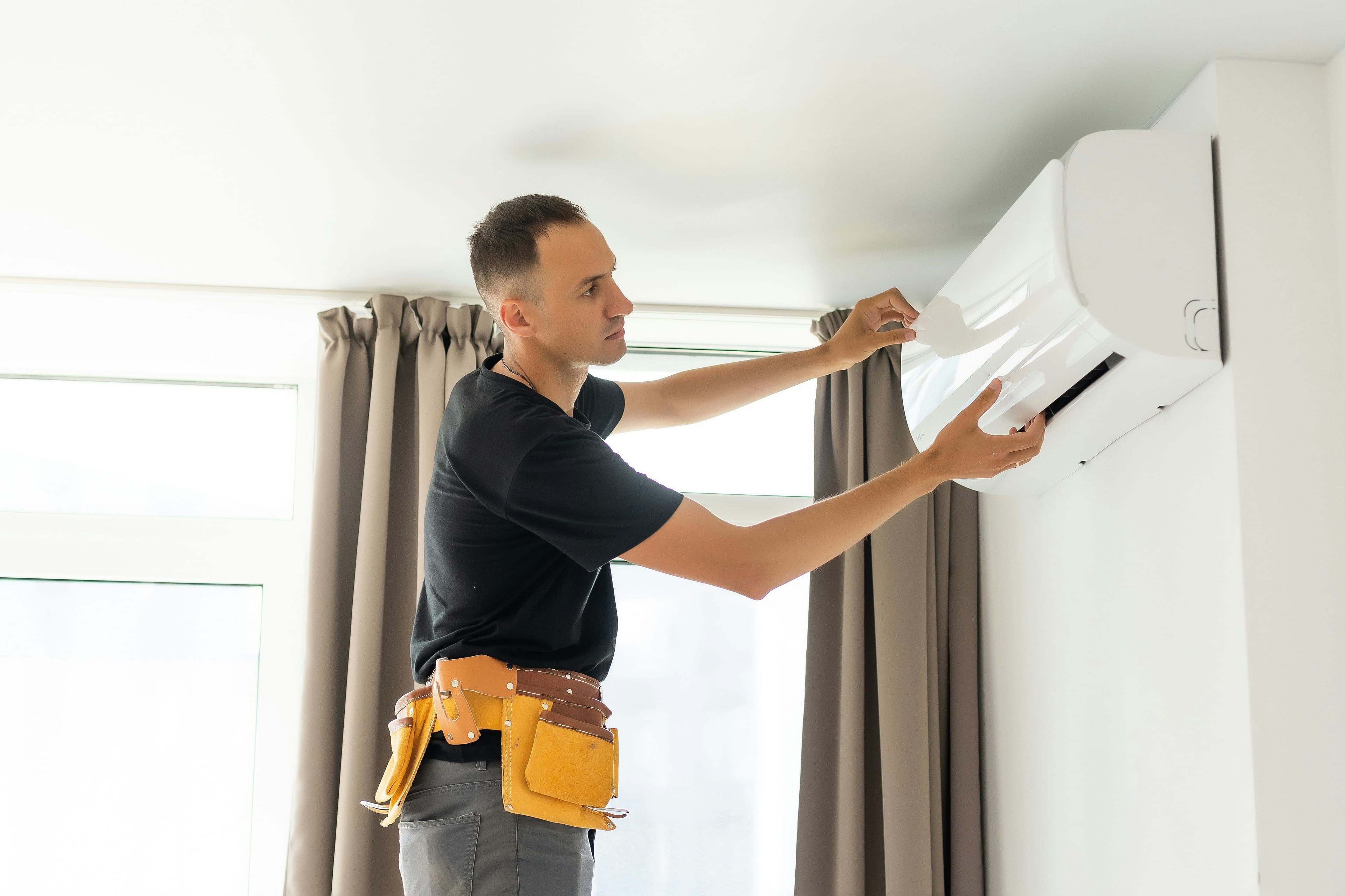
Cleaner air starts with better filtration.
Book Now
Why Colorado Makes Air Filtration More Important
Colorado's environment creates a higher than average airborne particle burden for Denver metro homeowners, making effective filtration more important here than in many other parts of the country.
Cottonwood Season Denver metro's legendary cottonwood season creates a massive annual allergen load that infiltrates homes through every opening and recirculates through HVAC systems for weeks. Standard filters are quickly overwhelmed and essentially useless against the fine cottonwood particles that penetrate deepest into your respiratory system. High-efficiency whole-home filtration handles cottonwood season dramatically better.
Wildfire Smoke Colorado's wildfire seasons have intensified dramatically in recent years. The fine particulate matter in wildfire smoke — PM2.5 and smaller — is the most dangerous component and the hardest to filter. Standard filters capture almost none of it. AprilAire high-efficiency media filters with MERV 11 to 16 ratings capture a significant portion of wildfire smoke particulates, providing meaningful protection during smoke events that standard filters simply cannot offer.
I-25 Corridor Pollution Vehicle emissions and construction dust along Denver metro's major corridors create elevated fine particle concentrations in nearby neighborhoods. Homes near major roadways experience continuous fine particle infiltration that standard filters barely address.
Dry Climate Colorado's low humidity keeps particles airborne longer than in more humid climates. In humid air, particles clump together and fall out of the air relatively quickly. In Colorado's dry air, fine particles stay suspended and recirculate through your HVAC system far longer, increasing the importance of effective filtration to capture them before they reach your lungs.
Altitude Denver metro's elevation means thinner air with less atmospheric filtration of outdoor pollutants before they reach ground level. Fine particles that would be filtered by more atmospheric layers at lower elevations arrive at your home in higher concentrations.

Your Service Process
- Rapid emergency response within hours
- Comprehensive system diagnosis and assessment
- Transparent pricing with detailed explanations
- Expert repair using quality replacement parts
- Thorough testing and performance verification
- Professional cleanup and maintenance recommendations
- Follow up service to ensure continued operation
Our Air Filtration Solutions
Powered by AprilAire — Professional Whole-Home Filtration
AprilAire whole-home media filter systems replace your standard 1-inch filter with a high-efficiency media filter in a purpose-built housing that integrates with your existing HVAC system. The result is dramatically better particle capture at MERV 11 to 16 ratings, without the airflow restriction that comes from forcing high-efficiency filtration through a standard 1-inch filter slot.
Why the housing matters: A MERV 13 filter placed in a standard 1-inch slot would restrict airflow so severely that it would damage your HVAC system. AprilAire's deep media filter housings, typically 4 to 5 inches deep, provide dramatically more filter surface area that allows high-efficiency filtration without restricting airflow. You get better particle capture and maintained airflow — not a trade-off between the two.
AprilAire media filter systems capture:
- Large particles such as dust, lint, and carpet fibers — MERV 1 to 4 range
- Medium particles such as pollen, pet dander, and mold spores — MERV 8 to 11 range
- Fine particles such as fine dust, bacteria, and some smoke particles — MERV 11 to 16 range
- Particles as small as 0.3 microns at the highest efficiency ratings
Best for:
- Homeowners with allergies or asthma
- Homes with pets
- Anyone wanting meaningfully better filtration than their current system provides
- Homes in areas with high outdoor particle loads such as near major roads, construction sites, or agricultural areas
- Colorado homeowners who want better wildfire smoke protection
Many Denver metro homes have HVAC systems that were installed with standard 1-inch filter slots, limiting the filtration efficiency that can be achieved without airflow problems. AprilAire filter upgrade systems solve this by installing a purpose-built filter cabinet that bypasses the original filter slot and provides the deep media filtration capacity that high-efficiency filtration requires.
A filter upgrade system is the right solution when:
- Your existing filter slot can only accommodate a 1-inch filter
- You want significantly better filtration but your current setup cannot support it
- You have tried high-MERV 1-inch filters and experienced airflow problems or system issues
- You want to eliminate the monthly cost and hassle of frequent standard filter replacement — AprilAire media filters typically last 6 to 12 months between replacements
Proper airflow is the foundation of effective filtration and of your HVAC system's overall performance. A system with restricted airflow — from an oversized filter, a collapsed duct, an undersized return, or a system that was not properly designed — cannot filter effectively because air does not pass through the filter at the right velocity and volume.
We evaluate your system's airflow as part of our filtration assessment and address any restrictions that are reducing both filtration effectiveness and HVAC performance. In many cases, improving airflow delivers immediate benefits in both air quality and system efficiency without adding any new equipment at all.
Common airflow issues we address:
- Undersized return air ducts that restrict system airflow
- Collapsed or damaged flex duct reducing airflow to specific areas
- Improperly sized filters for the system's airflow requirements
- Blocked or restricted supply registers
- Duct leakage that bypasses filtration entirely
What the Numbers Actually Mean for Your Home
MERV stands for Minimum Efficiency Reporting Value. It is the standardized measure of how effectively a filter captures particles of different sizes. Higher MERV ratings capture smaller particles more effectively. Here is what the ratings mean in practical terms for Denver metro homeowners:
MERV 1 to 4 — Standard 1-inch filters Captures large particles such as carpet fibers, lint, and large dust. Designed to protect your HVAC equipment. Minimal impact on indoor air quality.
MERV 5 to 8 — Mid-range filters Captures most pollen, larger mold spores, and pet dander. Better than standard filters but still misses the finest particles. Some airflow restriction can occur in tight 1-inch slots.
MERV 9 to 12 — High-efficiency residential range Captures fine dust, most mold spores, most pet dander, and some bacteria. Represents a meaningful improvement in indoor air quality. Requires proper housing to avoid airflow restriction.
MERV 13 to 16 — Premium residential range Captures fine particles including many bacteria, virus carriers, and fine smoke particles. Provides significant wildfire smoke protection. Requires an AprilAire deep media housing for residential application without airflow restriction.
MERV 17 to 20 — HEPA range Hospital-grade filtration. Not practical for most residential HVAC systems without significant airflow modification, as the restriction is too great for standard residential systems to handle effectively.
Our recommendation for most Colorado homes: MERV 11 to 13 in an AprilAire deep media housing. This provides meaningful improvement in allergen and particle capture, including better wildfire smoke protection, without the airflow restriction that limits higher-MERV filters in standard housings.
When your home's filtration is doing its job, everything improves.
Health Benefits:
- Reduced allergen exposure — less pollen, pet dander, and mold spores circulating through your home
- Reduced fine particle inhalation — the particles that penetrate deepest into respiratory tissue are captured before reaching your lungs
- Better wildfire smoke protection — high-efficiency filters capture a meaningful portion of fine smoke particulates
- Reduced bacterial exposure — MERV 13 and higher filters capture many airborne bacteria
- Improved allergy and asthma symptom management throughout your entire home
Home and HVAC Benefits:
- Cleaner HVAC coils — fewer particles reaching your indoor coil means better heat transfer and improved system efficiency
- Extended HVAC equipment life — less particle accumulation on blower wheels, coils, and heat exchangers
- Reduced dust accumulation on surfaces — less particle circulation means less dust settling on furniture, floors, and electronics
- Less frequent deep cleaning required
Practical Benefits:
- AprilAire media filters last 6 to 12 months compared to monthly replacement of standard filters, meaning less maintenance hassle for you
- No more choosing between air quality and system protection — AprilAire systems deliver both simultaneously
EXCELLENT
Based on 224 reviews

Nikki H.
We were lucky to have found Power Electrical. They have been an incredible asset to our property management company and do a great job in everything they do. Pricing is fair and communication is always clear and consistent. We highly recommend them for any of your needs and look forward to using them for many years to come.
Feb 24, 2026

Ryan S.
I’ve been doing business with Power Electrical Services for years. Owner is a stand up guy. Great service for a fair price. Always great communication. Respectful of your space and time. Don’t waste your time calling other electricians.
Feb 24, 2026

Kelley G.
Power Electrical was very communicative, quick and efficient. Quick and easy removal of Christmas lights.
Feb 24, 2026

Holly
I would highly recommend this electric company for any issue you may be having, the scheduling is fast and efficient and Lance had my faulty outlet back to working order fixing things that have not been working since I moved in a matter of minutes. Very friendly, personable and knowledgeable staff. Thank you Power electrical.
Feb 24, 2026

Audrey R.
Excellent as always! Power Electric is my go to!
Feb 24, 2026

W B.
Joey came out and did a fantastic job looking over and cleaning my system for the winter. I had someone come out earlier in the year, but it felt more like he was trying to get me to buy a new system than help with my existing. Joey looked over the system, gave a few small but very helpful suggestions, and cleaned it. Could not recommend these folks enough.
Feb 24, 2026

Matt O.
Dino, Isaiah, and Joey came to replace my old electrical panel and were awesome! Everything went smoothly, they were super knowledgeable and personable as well as professional. The price was fair, too. They are now going to be my primary electrical company going forward. Overall, I highly recommend Power Electrical Services for all your electrical needs! 5 stars across the board!
Feb 24, 2026

Kadence P.
The power electric team is phenomenal when it comes to customer service. They are friendly, kind, and extremely empathetic! Thank you all for your hardwork!
Feb 24, 2026

Luis M.
Installed electrical outlet - Lance completed the job professionally and took outmost care of the installation. Outstanding Job.
Feb 24, 2026

Joseph W.
I had power electric come out for a troubleshoot on my electrical system. They were professional, knowledgeable and efficient. They came out troubleshot, quoted repairs and performed repairs with a warranty. Couldn’t be happier!
Feb 24, 2026

Tyler S.
Very careful and efficient work from Isiah and Lance in replacing our electrical panel.
Feb 24, 2026

Kenny B.
I had purchased an oven and needed an outlet swap as soon as possible. Lance came out right at the beginning of the service window, was very thorough during the estimate procedure and was extremely knowledgeable and answered a lot of questions I had about my circumstance. Couldn't be happier with the communication and service performed. I will definitely utilize this company again in the future.
Feb 24, 2026

Max S.
Michael was great! High quality work and awesome communication
Feb 24, 2026

Cara W.
As always, amazing craftsmanship, customer service and pricing.
Feb 24, 2026

Heidi H.
Update April 2026: Joey came back for Spring A/C service and did a nice job. Good work at a good price. We like this company and will continue to use them. Previous: Just moved into our new (2000 build) house and Joey came out to do winter maintenance on our furnace. This company was recommended from the former owner. Joey was professional, polite and very helpful - showing me how to change the furnace filter and the humidifier pad. He cleaned out the furnace, inspected the system, (which is newer) and told me everything was in good shape – didn’t try to sell me anything extra. I like them and will use them again.
Feb 24, 2026
Financing Options
We offer financing options to help you get the job done. Please contact us for more information.
Service Plan Memberships
We offer financing options to help you get the job done. Please contact us for more information.
Areas we Serve
The Air Filtration Services Professionals
- Dust reappears quickly after cleaning — surfaces you just dusted are dusty again within days
- Allergy or asthma symptoms are consistently present at home
- Pet odors and dander persist despite regular grooming and cleaning
- Your HVAC filter looks dirty within weeks of replacement
- Symptoms worsen during cottonwood season or wildfire smoke events despite staying indoors
- Visible dust accumulates on supply registers and vents
- Your current filter is a standard 1-inch fiberglass or low-MERV filter
- We evaluate your current filtration setup including filter type, MERV rating, housing configuration, and airflow
- We assess your home's specific particle challenges such as allergens, pets, location, and wildfire smoke exposure
- We recommend the right AprilAire filtration solution for your home and HVAC system
- We install your chosen system professionally, fully integrated with your existing HVAC
- We verify proper airflow after installation — filtration that restricts airflow defeats its own purpose
- We set your filter replacement schedule and walk you through maintenance before we leave
Cleaner air starts with better filtration.
- AprilAire Authorized Installer — We install the brand that HVAC professionals trust for whole-home filtration
- Electrical and HVAC Under One Roof — Filtration upgrades involve HVAC integration and sometimes electrical connections — we handle both in a single visit
- Family-Owned and Operated — A local Colorado team that understands the specific filtration challenges our cottonwood seasons and wildfire smoke events create
- Licensed and Insured — Professional installation by licensed HVAC technicians
- Honest MERV Guidance — We explain what each rating actually does and recommend what is right for your home, not just the most expensive option
- No Upselling — We assess your specific situation and recommend the filtration level that actually addresses your home's needs
- 5.0 Rating — 202 Reviews — Our customers speak for themselves
Better filtration. Cleaner air. Healthier home.
1. What is a MERV rating and what does it mean? MERV stands for Minimum Efficiency Reporting Value. It is the standardized measure of how effectively an air filter captures particles of different sizes as air passes through it. The scale runs from 1 to 20, with higher numbers indicating more effective filtration of smaller particles. A MERV 1 filter captures large visible particles such as lint and carpet fibers. A MERV 13 filter captures fine dust, most mold spores, many bacteria, and a meaningful portion of wildfire smoke particles. A MERV 17 to 20 filter in the HEPA range captures virtually everything but restricts airflow too severely for most residential HVAC systems. For most Denver metro homeowners, the practical sweet spot is MERV 11 to 13 in an AprilAire deep media housing, providing meaningful health benefits without airflow problems.
2. What is the difference between a standard filter and a whole-home media filter? A standard 1-inch filter sits in your existing filter slot and captures large particles, primarily to protect your HVAC equipment. It is inexpensive, replaced monthly, and has minimal impact on your indoor air quality beyond removing the largest particles. A whole-home media filter system like those offered by AprilAire installs a purpose-built deep filter housing in your HVAC system that accommodates a high-efficiency 4 to 5 inch thick media filter. The deeper housing provides dramatically more filter surface area, allowing high-efficiency MERV 11 to 16 filtration without the airflow restriction that would damage your system if you forced a high-MERV filter into a standard 1-inch slot. The media filter also lasts 6 to 12 months rather than one month, reducing replacement hassle. The result is dramatically better particle capture, maintained airflow, and less frequent maintenance at the cost of the initial installation investment.
3. Can a high-MERV filter damage my HVAC system? A high-MERV filter in the wrong housing can absolutely damage your HVAC system, and this is a genuine concern that keeps many homeowners from upgrading their filtration. Here is what happens: a dense high-MERV filter placed in a standard 1-inch slot restricts airflow severely. Your HVAC system's blower has to work harder to pull air through, increasing energy consumption, straining the blower motor, and reducing airflow to your living spaces. Over time, this can cause the indoor coil to ice over, the heat exchanger to overheat, and the blower motor to fail prematurely. The solution — and the reason we install AprilAire deep media systems rather than simply recommending high-MERV 1-inch filters — is that the deep media housing provides enough filter surface area that even a high-efficiency MERV 13 filter does not restrict airflow. You get better filtration without the airflow problems. Never place a MERV 13 or higher filter in a standard 1-inch slot, as it will cause damage to your system.
4. How often should I change my air filter? The answer depends entirely on what type of filter you have. Standard 1-inch filters should be replaced every 30 to 60 days for most homes, and more frequently in homes with pets or during high-particle seasons like cottonwood season. A quality 1-inch pleated filter might last 90 days in a home without pets or significant particle sources. AprilAire whole-home media filters, because of their dramatically larger surface area, typically last 6 to 12 months before replacement is needed. The actual replacement interval depends on your home's particle load — homes with multiple pets, near construction sites, or in high-cottonwood areas may need replacement on the shorter end of that range. We assess your specific situation and recommend a replacement schedule during installation, and AprilAire filter replacement is something we handle as part of your annual maintenance visit.
5. Will a better air filter help with allergies? Yes — meaningfully so for most allergy sufferers. The particles that trigger allergic responses, including pollen, pet dander, mold spores, and fine dust, are precisely the particles that standard filters miss and high-efficiency media filters capture effectively. By capturing these particles before they recirculate through your home, a MERV 11 to 13 whole-home media filter reduces your continuous allergen exposure significantly — not just when you are in one room with a portable air purifier, but throughout your entire home every time your HVAC runs. The improvement is typically most noticeable during high-allergen seasons like Colorado's cottonwood season. Homeowners with whole-home high-efficiency filtration consistently report better symptom management during these periods compared to those using standard filtration. For best results, whole-home filtration works most effectively when combined with proper ventilation and, where indicated, air purification.
6. Does air filtration help with wildfire smoke? Yes, but the effectiveness depends on the filter's MERV rating. Standard 1-inch filters capture almost none of the fine particulate matter — PM2.5 and smaller — that makes wildfire smoke dangerous. The particles that penetrate deepest into lung tissue and cause the most significant health harm are the ones standard filters miss entirely. AprilAire whole-home media filters at MERV 13 capture a meaningful portion of fine smoke particles, providing significantly better protection during smoke events than standard filtration. MERV 16 filters capture even more. No residential filtration system captures all wildfire smoke particles — the finest particles require HEPA-level filtration that most residential systems cannot support without significant modification. However, upgrading from standard to AprilAire high-efficiency media filtration provides a real and meaningful improvement in wildfire smoke protection that Colorado homeowners in increasingly smoke-affected areas should seriously consider.
7. What MERV rating do I need for my home? The right MERV rating depends on your home's specific particle challenges and your HVAC system's configuration. For most Denver metro homeowners, our recommendation is MERV 11 to 13 in an AprilAire deep media housing. This captures the particles that most significantly affect indoor air quality and health without airflow restriction. Homes with multiple pets, family members with significant allergies or asthma, or homes in areas with heavy wildfire smoke exposure may benefit from MERV 13 to 16. Homes where the primary concern is basic equipment protection and large particle capture, with no significant allergy or health concerns, may be well served by MERV 8 in an appropriate housing. We assess your specific home, HVAC configuration, particle challenges, and health needs, and recommend the right rating honestly rather than defaulting to the highest and most expensive option.
Related Services

Ready to Upgrade Your Home's Filtration? Let's Get It Done.
Stop recirculating the same particles through your home every time your HVAC runs. Call us for a professional filtration assessment and find out what AprilAire solution is right for your specific situation.